
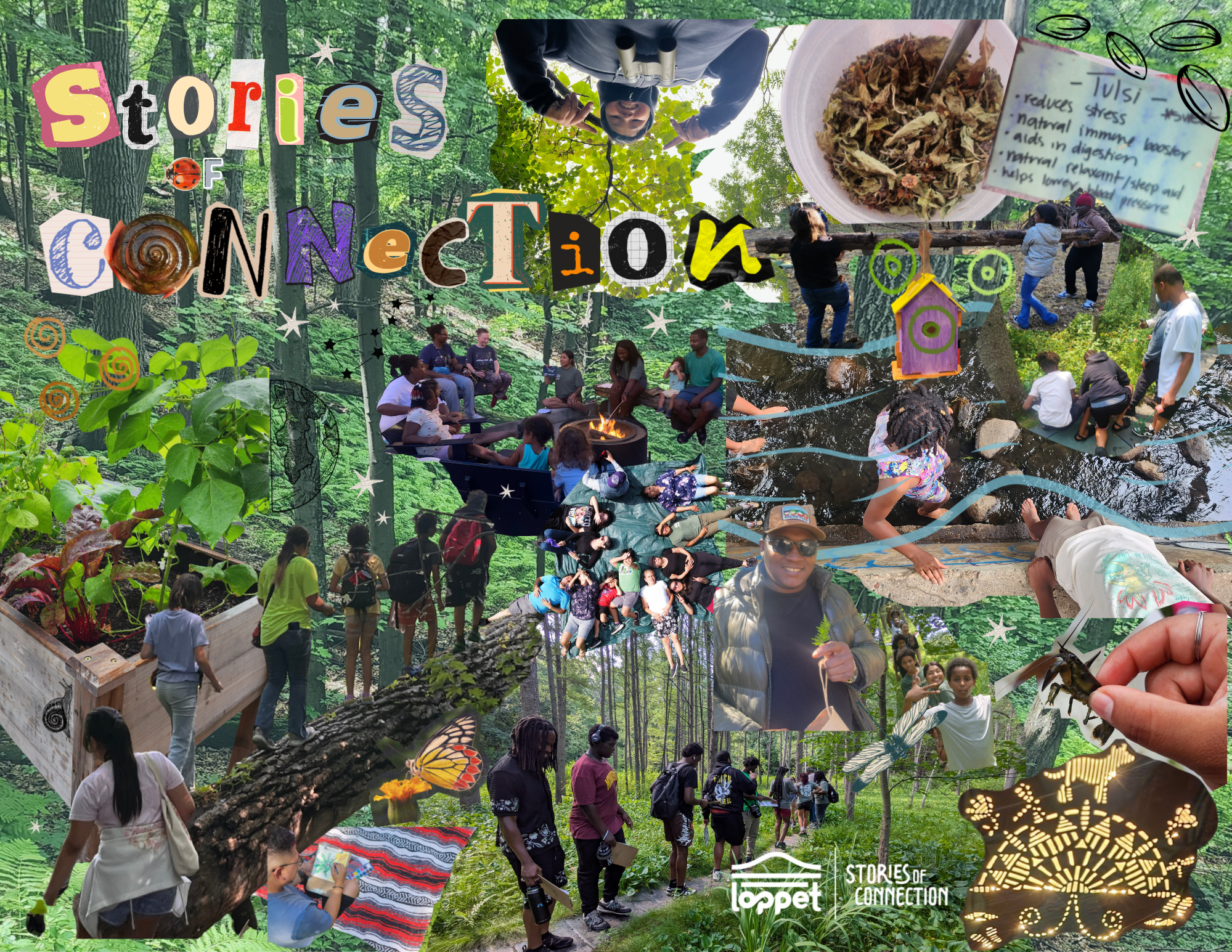
Photo courtesy of The Loppet’s Stories of Connection.
Dear Northside,
As I reflect on the past two years of the Stories of Connection project, I find myself thinking less about the project itself and more about what it has meant to be welcomed into a deeper conversation with a community I love.
Stories of Connection gave me the extraordinary opportunity to be part of something that believed our community deserved to be seen, heard, and understood on its own terms. At the heart of this work was a simple but powerful question: What is our connection to nature and the outdoor green spaces that surround us? But as we listened, created, gathered, and shared stories, it became clear that this question was about so much more than parks and trails. It was about history. It was about access. It was about memory, belonging, identity, and the ways history shapes how a community sees itself—and how others see us.
The Northside has always been more than the stories that have been told about it.
Long before today’s narratives took hold, North Minneapolis was a place where families built lives, businesses opened their doors, children played in the streets and went home before the street lights came on, neighbors looked after one another, and communities created spaces of belonging. Jewish, Black, and White families lived, worked, worshiped, raised children, and built businesses here. There was culture, commerce, faith, music, food, art, and community life. There were places that became more than businesses—they became part of our collective memory.
I think about Snow Foods. I think about Lucille’s Kitchen, The Way, and the many other gathering places that gave people somewhere to go, somewhere to meet, somewhere to eat, somewhere to celebrate, and somewhere to simply be. These places are reminders that the Northside has always had a culture of connection.
And yet, over time, stories about our community became increasingly shaped by what was missing rather than what was present. Historical disparities in housing, employment, transportation, investment, environmental access, and opportunity left deep marks. Those disparities did not simply affect where people lived or what resources were available to them. They influenced how our neighborhoods were described, how our people were perceived, and eventually created myths about North Minneapolis that too often became accepted as truth.
Stories of Connection reminded me that we have the power to tell a different story—not by denying our history, but by telling all of it.
Our history includes struggle, but it also includes brilliance.
It includes loss, but it also includes love.
It includes inequity, but it also includes resistance.
It includes hardship, but it also includes beauty.
The Northside is a place of artists, educators, entrepreneurs, musicians, organizers, elders, young people, families, dreamers, builders, and storytellers. It is a place of tremendous talent and creativity. It is a place where people continue to find ways to care for one another and create something beautiful, even when the circumstances around them have not always made that easy.
Through this project, I had the privilege of witnessing that beauty in a new way.
As the Art Curator and Community Liaison for Stories of Connection, I was honored to work alongside artists who helped us see our community through different lenses. Their work asked us to think about liberation, nature, healing, growth, perception, and reconnection. They reminded us that art can do something powerful: it can interrupt the stories we have inherited and invite us to imagine something more expansive.
I am grateful for every artist who trusted this process. I am grateful for every community organization that opened its doors. I am grateful for every person who stopped to look at a piece of art, shared a memory, participated in a conversation, or simply said, “This feels like us”.
And I am especially grateful for the opportunity to serve.
Serving as an Art Curator and Community Liaison was never simply about placing artwork on walls or coordinating community events. It was about listening. It was about building bridges. It was about creating opportunities for our community to recognize itself in the work. It was about honoring the stories that have been carried by those who came before us while creating room for the stories that are still being written. More importantly, it was about doing right by the Northside.
The Northside has a legacy worth honoring.
We honor the people who built businesses when resources were scarce.
We honor the families who stayed and raised generations of children.
We honor the elders who remember what our neighborhoods looked like before the stories changed.
We honor the artists who have always found ways to create.
We honor the organizers who fought for better schools, safer neighborhoods, economic opportunity, and access to green spaces.
We honor the entrepreneurs who opened doors and created gathering places.
We honor the young people who continue to imagine a Northside that reflects their dreams.
And we honor the places that live in our collective memory—the grocery stores, restaurants, community centers, churches, parks, theaters, and neighborhood businesses that helped make North Minneapolis a community rather than simply a geographic location.
There is something powerful about remembering.
Because when we remember who we were, we are better able to understand who we are.
And when we understand who we are, we can begin to imagine who we can become.
That may be the greatest gift Stories of Connection has given me.
It reminded me that our relationship with outdoor green spaces is also a relationship with history. A park is not simply a patch of grass. A trail is not simply a path. A garden is not simply a garden. These spaces hold memories. They hold possibility. They provide places for children to play, elders to gather, families to breathe, artists to create, neighbors to connect, and communities to heal.
Reconnecting with nature is, in many ways, reconnecting with ourselves.
And perhaps that is why this work mattered so deeply.
For two years, I had the honor of helping create spaces where the Northside could tell its own story—through art, through conversation, through memory, and through connection. I leave this chapter with an even deeper appreciation for the richness of this community and for the people who continue to make it what it is.
So this is my love letter to the Northside.
I love your resilience.
I love your creativity.
I love your contradictions and your complexity.
I love the stories that have survived.
I love the stories that are still waiting to be told.
I love the people who continue to show up.
I love the beauty that exists in places where others sometimes refuse to look for it.
And I am proud.
Proud of the people who call the Northside home.
Proud of the artists who continue to give us new ways to see ourselves.
Proud of the elders who carry our history.
Proud of the young people who are creating our future.
Proud of the businesses, organizations, cultural institutions, and community spaces that continue to create connections.
And I am deeply honored that, for these past two years, I was able to serve my community.
I began this journey thinking I was helping curate an art project.
I leave understanding that I was helping curate something much larger: memory, connection, visibility, legacy and possibility.
The Northside does not need anyone to tell us that we have value.
We know.
But sometimes we need spaces that remind us.
We need spaces that allow us to see our history, our beauty, our resilience, and our future reflected back to us.
Stories of Connection was one of those spaces.
And my hope is that the conversation does not end here.
May we continue to tell our stories.
May we continue to honor those who came before us.
May we continue to protect and create spaces where our children can see themselves reflected.
May we continue to challenge the myths that have been placed upon our community.
May we continue to nurture our connection to one another and to the natural spaces that belong to all of us.
And may we never forget that the Northside is not simply a place that has survived.
It is a place that continues to live, create, love, grow, and become.
With love, pride, and deep gratitude,
Kimberly Jones, Art Curator & Community Liaison
Stories of Connection Project
